
Resources
AI phone answering service: how it books appointments
Missed calls are quietly draining your appointment book
Your phone rings while you are with a customer, and the call goes to voicemail. Most callers never leave a message. They dial the next business on the list, and the appointment that should have been yours lands on a competitor's calendar. An AI phone answering service ends that leak by picking up every call, every time, and booking the appointment on the spot.
An AI receptionist answers, qualifies, and books without a human
An AI phone answering service is software that answers your business line with a natural voice, understands what the caller wants, and completes the task in real time. It is not a phone tree. Callers do not press 1 for hours or 2 for bookings. They simply talk, the way they would to a front desk employee.
AI phone answering service: Software that picks up your business calls, holds a natural spoken conversation, and completes tasks like booking appointments without a human on the line.
Modern systems handle far more than greetings. A well built AI receptionist can:
- Answer common questions about hours, pricing, location, and services using your own business information
- Check your real calendar and offer open slots, then book, reschedule, or cancel appointments directly
- Send the caller a confirmation by text message and log the interaction in your CRM
- Recognize calls it should not handle, such as emergencies or complex complaints, and transfer them to a human
The result is missed call recovery at full scale. The phone gets answered at 9 pm on a Sunday, during your lunch rush, and while every staff member is busy with customers. Most teams that track it report that a meaningful share of their bookings start arriving outside business hours within the first month.
How does an AI phone answering service book appointments automatically?
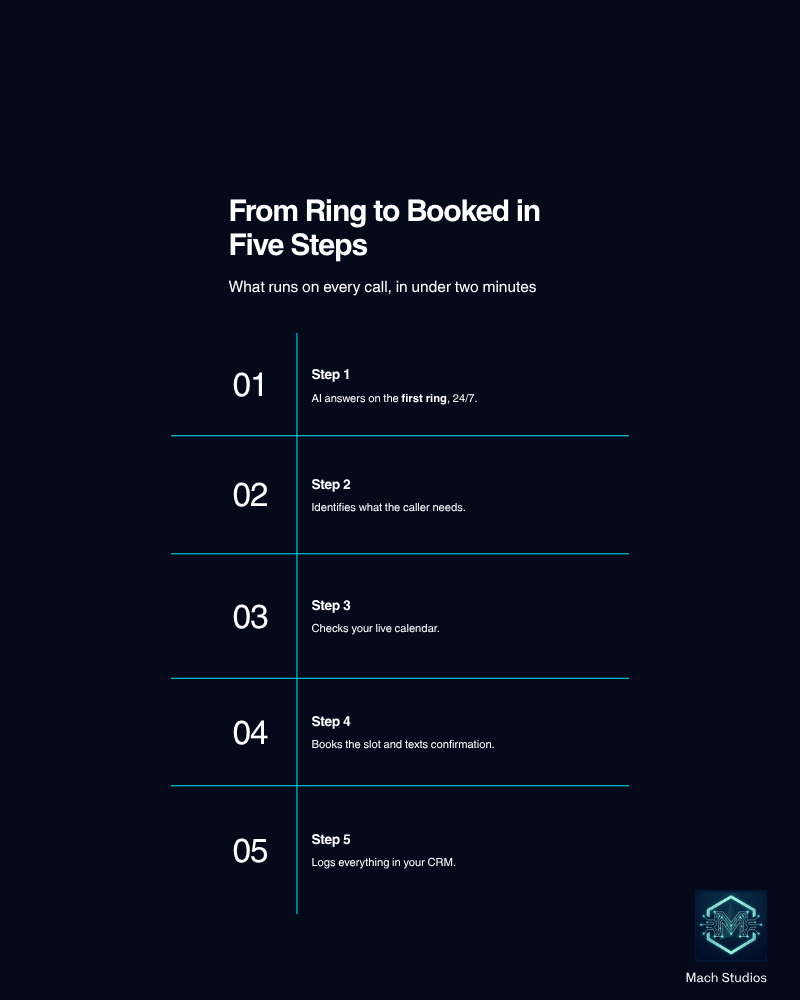
It books appointments by connecting three things: a voice AI that talks to the caller, your live calendar, and your booking rules. Here is the exact sequence that runs on every call, usually in under two minutes:
- The AI answers the call. It greets the caller by your business name, in a voice you chose, with no hold time. This happens on the first or second ring, 24 hours a day.
- It identifies the intent. The caller says something like "I need a haircut Thursday afternoon" or "Can I get a consultation next week?" The AI extracts the service, the preferred time, and any details it needs.
- It checks your real availability. The system queries your actual scheduling tool, whether that is Google Calendar, Calendly, Acuity, or a vertical platform like Mindbody or Jane. It only offers slots that are open right now.
- It books and confirms. The AI reserves the slot, collects the caller's name and phone number, and sends a text confirmation before the call ends. Your calendar updates instantly.
- It logs and follows up. The call summary, transcript, and contact details land in your CRM. Automated reminders go out before the appointment, which most businesses find cuts no-shows noticeably.
Every step follows rules you set. You decide which services it can book, how much buffer time each appointment needs, which calls get transferred to a human, and what it should never promise a caller.
A real example: the barbershop that stopped losing Saturdays
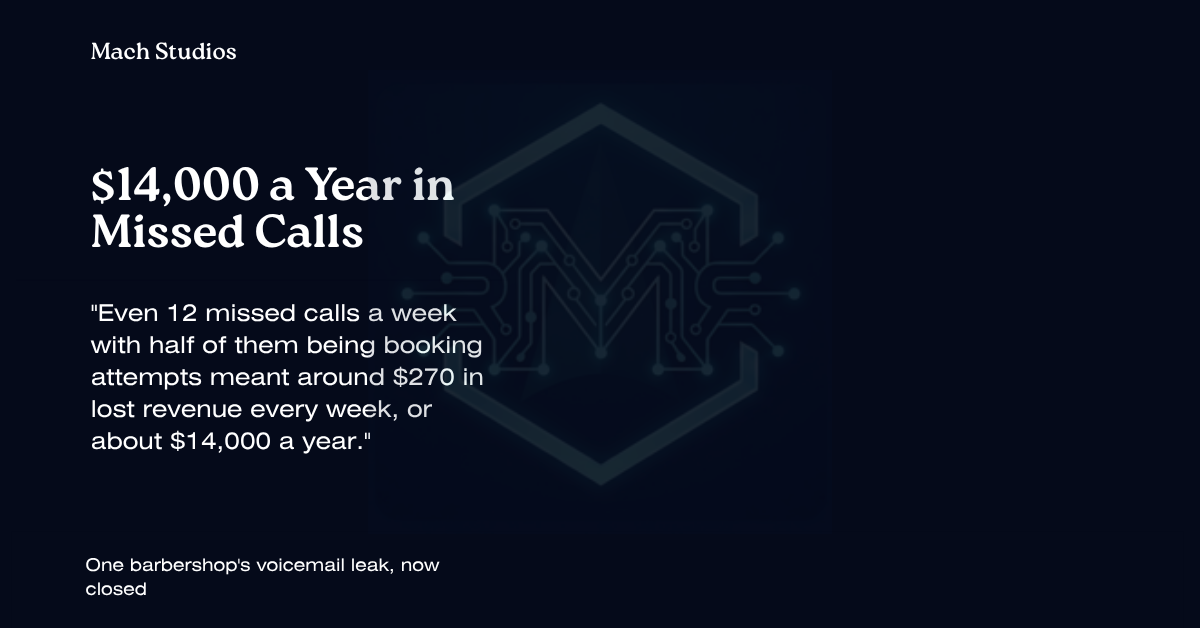
Consider a two-chair barbershop that gets 40 to 60 calls a week. Before automation, the owner answered between cuts. Roughly a third of calls went to voicemail, and almost none of those callers called back. At an average ticket of $45, even 12 missed calls a week with half of them being booking attempts meant around $270 in lost revenue every week, or about $14,000 a year.
After Mach Studios deployed an AI phone answering system connected to the shop's booking platform, the picture changed in the first 30 days:
- Every call answered, including the 35 percent that previously hit voicemail
- Bookings made after closing time, which had never happened before, became roughly 1 in 5 of all new appointments
- The owner stopped touching the phone mid-cut, and walk-in customers got full attention
The same pattern holds for health clinics, gyms, law firm intake lines, and real estate agents who cannot answer while showing a property. The vertical changes, the math does not.
What this means for how you run your business
The practical change is that your phone stops being a task and starts being an asset. No staff member has to stop revenue-generating work to answer a routine booking call. No caller hears voicemail and moves on to a competitor. Your calendar fills while you sleep, and every interaction is logged without anyone typing notes.
For a typical appointment-based business, that translates to three concrete outcomes: more booked appointments from the same call volume, lower front desk labor spent on routine scheduling, and fewer no-shows thanks to automatic confirmations and reminders. A virtual receptionist powered by AI costs a fraction of a part-time hire and never calls in sick.
The businesses that benefit most are the ones whose phones ring when nobody can answer: solo operators, small teams at peak hours, and any business that gets after-hours demand.
If you want this running for your business, Mach Studios handles the build end to end, from connecting your calendar to training the AI on your services and pricing. Book a free audit and we will scope it for you.
Frequently asked questions
Will callers know they are talking to an AI?
Usually yes, and that is fine. Modern voices sound natural, and most callers care about speed, not who answers. The AI can also disclose itself upfront, which builds trust. What callers notice most is that the phone got answered immediately and their appointment got booked in one call.
What happens if the AI cannot handle a call?
It transfers. You define escalation rules during setup, such as emergencies, billing disputes, or callers who ask for a human. The AI forwards those calls to your cell or front desk and sends a summary of what was said, so the handoff loses no context.
How long does setup take?
Most builds go live in 1 to 2 weeks. The work involves connecting your calendar and CRM, loading your services, pricing, and policies, setting booking rules, and testing real call scenarios. Mach Studios handles all of it, and you approve the AI's behavior before it ever answers a live call.
Key takeaways
- Every missed call is a likely lost appointment, and an AI phone answering service removes that leak by answering 24 hours a day.
- The AI books real appointments by checking your live calendar, confirming by text, and logging everything in your CRM automatically.
- Setup takes 1 to 2 weeks with a done-for-you build, and the system follows booking and escalation rules you control.